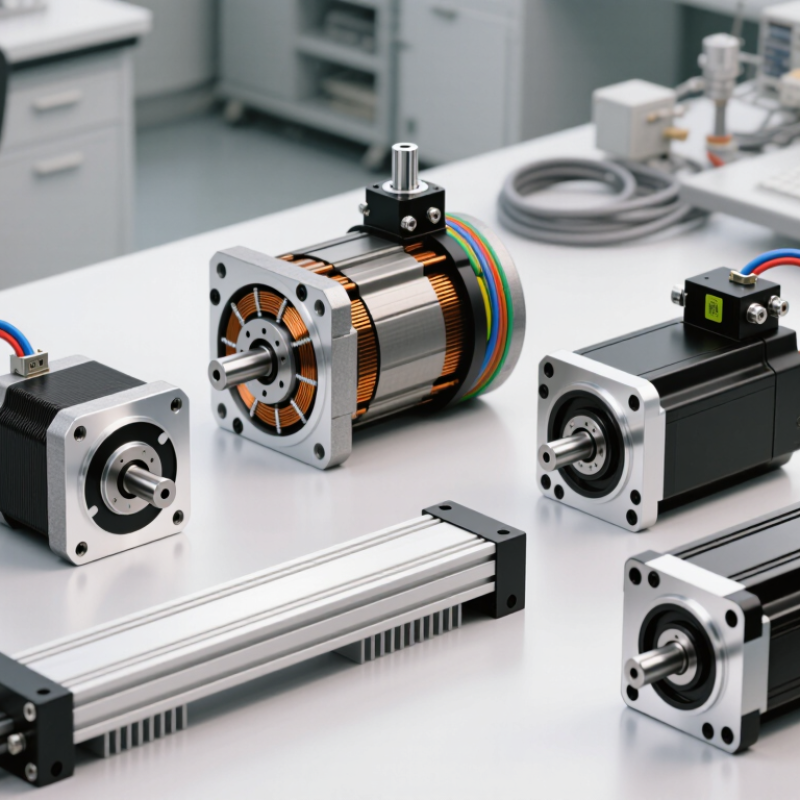
2026 Top Types of Precision Motors for Global Buyers?

Time:2026-10-07 Author:Isabella
0%

Choosing the right Precision Motors in 2026 requires more than comparing rated speed and purchase price. Global buyers now evaluate motion accuracy, energy use, thermal stability, noise, and service support together. A motor that performs well on a clean laboratory bench may struggle beside dust, vibration, or fluctuating voltage.

This guide introduces the main types used across robotics, medical equipment, packaging lines, semiconductor tools, and advanced manufacturing. It examines servo motors, stepper motors, brushless DC motors, torque motors, linear motors, and integrated motor systems. Each type offers a different balance of torque, positioning accuracy, response time, control complexity, and maintenance needs. Small details matter. A feedback cable, encoder resolution, or cooling path can change the complete system result.

Experienced engineers usually begin with the load profile, not the catalog cover. They check acceleration curves, duty cycles, backlash, operating temperature, ingress protection, and controller compatibility. Supplier documentation, testing records, warranty terms, and quality certifications also deserve careful review. These checks improve reliability across different regions and installation conditions. Still, no comparison is perfect. Real-world performance can differ because installation quality, tuning skills, and mechanical alignment vary widely.

The 2026 market may offer impressive specifications, but buyers should question unclear efficiency claims and incomplete lifecycle data. A lower initial price is not always economical after downtime, replacement parts, and technical support are included. This overview provides a practical framework for comparing motor technologies with greater confidence. It also leaves room for judgment, because the best choice depends on the machine, environment, and people operating it.

2026 Top Types of Precision Motors for Global Buyers?

What Precision Motors Are and Why Global Buyers Need Them

Precision motors convert electrical energy into highly controlled motion. They are built for accuracy, repeatability, speed control, and stable torque. Global buyers use them in robots, CNC equipment, packaging lines, medical devices, and laboratory automation.

The main types include servo motors, stepper motors, brushless DC motors, linear motors, and direct-drive torque motors. Servo motors suit dynamic systems requiring encoder feedback and rapid correction. Stepper motors offer simpler positioning, although missed steps remain a practical risk. Linear motors move loads directly along a track. Torque motors deliver smooth rotary force without traditional gear reduction. The right choice depends on load inertia, duty cycle, backlash tolerance, heat, and available maintenance skills.

Demand is becoming easier to understand through industrial data. The International Federation of Robotics reported 541,302 industrial robot installations worldwide in 2023, with more than 4.2 million robots operating globally. Each robot depends on multiple controlled axes, increasing the need for reliable motion components. The International Energy Agency has also reported that electric motor systems can represent roughly half of global electricity consumption in industrial contexts. Efficiency matters.

Small errors become expensive.

In field testing, buyers should examine encoder resolution, repeatability, overload capacity, vibration, and performance after thermal growth. Datasheets rarely show every factory condition. Humidity, dust, long cable runs, and inconsistent tuning can reduce real-world accuracy. Certification, service access, and lifecycle energy use also deserve attention. Precision is not only a motor specification; it is a system result.

How Major Precision Motor Types Work and Differ

2026 Top Types of Precision Motors for Global Buyers

Stepper motors move through fixed magnetic steps. They offer simple positioning and strong holding torque at low speed. However, missed steps can remain invisible without feedback.

Servo motors close the loop with an encoder. They continuously correct position, speed, and load changes. This makes them suitable for robotic joints, inspection tables, and high-speed machining.

Brushless DC motors use electronic commutation instead of mechanical brushes. They run efficiently and quietly, but their control system requires careful tuning.

Voice coil motors create short linear movement through magnetic force. They respond quickly, though their travel range is usually limited.

The practical difference is not only accuracy. It also includes heat, noise, acceleration, duty cycle, and maintenance access. Direct-drive torque motors remove gear backlash and deliver smooth rotary motion. Yet they can demand larger controllers and stronger mechanical support.

In field testing, cable flexibility and encoder alignment often affect results more than expected. A specification sheet may look perfect. Real loads are rarely so polite. Engineers should compare repeatability under temperature changes, not only laboratory positioning data.

Tips: Match the motor to the load profile, not the catalog label. Check peak torque, continuous torque, inertia, and braking needs. Test the complete assembly with real cables and fixtures. Leave thermal margin. It prevents many expensive surprises. Also question whether absolute feedback is necessary; sometimes it adds cost without improving the process.

Key Performance Specifications for Comparing Precision Motors

In 2026, global buyers will compare servo, stepper, voice-coil, and direct-drive torque motors. The motor type matters, but specifications decide suitability. The U.S. Department of Energy reports that motor-driven equipment uses about 70% of industrial electricity. Therefore, efficiency deserves equal attention with peak speed.

Check continuous torque before peak torque. A motor rated for 2 Nm continuously may reach 6 Nm briefly, but not during constant production. Compare speed at the working load, not the catalog maximum. Positioning accuracy, repeatability, encoder resolution, and backlash also require separate review. A high-resolution encoder does not automatically create better machine accuracy. The mechanical frame may flex first.

Thermal performance is often underestimated. Review winding temperature, cooling method, duty cycle, and allowable overload time. The International Energy Agency estimates that electric motor systems consume roughly half of global electricity, making heat losses commercially important. Also examine torque ripple, rotor inertia, vibration, ingress protection, and expected service life. A direct-drive motor can remove gearbox backlash, but it may require a larger frame and stronger control tuning. A stepper motor can be economical, yet missed steps remain a risk under sudden loads. Specifications look precise. Real machines are less obedient.

For supplier comparison, request: speed-torque curves, efficiency maps, encoder details, test conditions, and IEC 60034 compliance evidence. Verify whether accuracy figures include the drive, coupling, temperature, and payload. Those small details can change the buying decision.

Which Precision Motor Fits Each Industrial Application

In 2026, precision motor selection should begin with the machine task, not a catalog speed rating. Servo motors fit robotic joints, packaging axes, and CNC feed systems requiring rapid acceleration and closed-loop positioning. Encoder feedback corrects load changes, but tuning still matters when belts stretch or tools vibrate. For indexing tables and compact feeders, stepper motors often provide economical repeatability at moderate speeds. They can lose position under overload, especially without feedback. That limitation is easy to underestimate.

Brushless DC motors suit fans, pumps, conveyors, and inspection spindles needing efficient continuous rotation. Add feedback when speed stability affects measurement quality. Direct-drive torque motors work well in rotary tables and precision handling systems, where backlash must remain extremely low. Linear motors serve fast pick-and-place slides and precision stages, eliminating screw contact but demanding careful thermal control. Heat can quietly reduce accuracy.

Application conditions decide the final fit. Check peak torque, continuous torque, acceleration, duty cycle, positioning tolerance, noise, ingress protection, and available voltage. Global buyers should also verify regional certifications and technical documentation. In dusty plants, sealed construction and cable routing may matter more than maximum resolution. For cold storage or clean production, confirm lubrication, materials, and operating limits. Request test data at the real load, not only empty-shaft specifications. A motor may meet the brochure target and still miss the machine target. Leave margin for friction, aging, and imperfect installation. Selection is rarely perfect.

2026 Top Types of Precision Motors for Global Buyers — Which Precision Motor Fits Each Industrial Application?

A practical comparison of commonly used precision motor technologies. Performance values are typical engineering ranges and vary with motor size, drive electronics, load inertia, thermal conditions, mechanical transmission, and tuning.

Precision Motor Type Motion and Control Principle Typical Feedback Configuration Typical Speed Range Positioning Capability Typical Torque or Force Profile Best-Fit Industrial Applications Main Advantages Important Selection Considerations
AC Servo Motor Closed-loop synchronous motor controlled by a servo drive using current, velocity, and position loops. Usually an incremental or absolute encoder; resolver feedback is also used in demanding environments. Approximately 1,000–6,000 rpm for many industrial models; higher speeds are available in specialized designs. High dynamic positioning accuracy; repeatability is mainly determined by encoder resolution, mechanics, tuning, and compliance. High continuous torque with strong short-duration overload capability and rapid acceleration. Robotic joints, CNC axes, packaging machines, printing equipment, semiconductor handling, and automated assembly. Excellent dynamic response, high efficiency, accurate torque control, and reliable operation under changing loads. Higher system cost and greater commissioning complexity than open-loop stepper systems; the gearbox, coupling, and machine structure still affect final accuracy.
Closed-Loop Stepper Motor Hybrid stepper motor operated by a pulse or field-oriented drive with position correction from feedback. Incremental encoder is common; some systems use magnetic or absolute position sensing. Typically 300–2,000 rpm, with useful torque decreasing as speed increases. Good low-speed positioning and repeatability when properly sized; closed-loop operation reduces loss-of-step risk. High holding torque and strong low-speed torque; limited high-speed torque compared with many servo motors. Compact linear stages, laboratory automation, labelers, small pick-and-place equipment, valves, and indexing mechanisms. Lower cost than many servo systems, simple digital command interface, strong holding capability, and good low-speed control. Can resonate, generate acoustic noise, and produce more heat; acceleration and speed must be checked against the load and inertia.
Open-Loop Stepper Motor Incremental motion produced by energizing stator phases in a fixed step sequence without position feedback. None in the basic configuration; an external sensor can be added for monitoring. Typically 100–1,000 rpm depending on motor size, drive voltage, load, and required torque. Nominal step angle is commonly 1.8° or 0.9°; microstepping improves smoothness but does not guarantee equivalent absolute accuracy. High static holding torque; available torque falls substantially as operating speed rises. Low-cost indexing, 3D printers, small motion stages, feeders, laboratory instruments, and non-critical positioning axes. Simple architecture, economical drive electronics, predictable incremental motion, and strong holding torque without a brake. The controller cannot detect missed steps; resonance, thermal rise, and load disturbances can cause position loss.
Brushless DC Motor Electronically commutated permanent-magnet motor, commonly controlled for speed or torque rather than extremely precise position. Hall sensors, incremental encoders, resolvers, or sensorless estimation. Approximately 1,000–20,000 rpm depending on winding, pole count, cooling, and application. Good speed regulation; precise positioning requires encoder feedback and a suitable servo controller. Efficient continuous operation with low maintenance and moderate to high power density. Pumps, fans, compressors, medical equipment, inspection systems, battery-powered machinery, and high-speed spindles. Long service life, no brush wear, high efficiency, compact construction, and broad speed capability. Requires electronic commutation; sensorless control may have limited low-speed starting and positioning performance.
Permanent-Magnet Synchronous Motor Synchronous permanent-magnet motor operated with vector or field-oriented control for efficient torque production. Resolver, encoder, Hall sensors, or sensorless estimation depending on performance requirements. Typically 500–6,000 rpm; field-weakening can extend the speed range in suitable designs. High speed and torque regulation when used with a closed-loop drive; mechanical transmission determines system-level accuracy. High efficiency and power density with strong continuous torque; suited to steady and dynamic loads. Industrial automation, energy-efficient pumps, machine tools, compressors, conveyors, and high-duty-cycle equipment. Efficient operation, low rotor losses, good thermal performance, and strong torque-to-volume ratio. Requires compatible drive tuning and careful thermal design; permanent magnets can impose cost and temperature constraints.
Direct-Drive Torque Motor Large-diameter, low-speed permanent-magnet motor directly coupled to the rotating load without a conventional gearbox. High-resolution encoder or resolver, often with a separate commutation sensor. Typically 10–1,000 rpm, depending on diameter, pole count, and torque requirement. Very high angular accuracy and repeatability when paired with a rigid structure and high-resolution feedback. High continuous torque at low speed, high peak torque, and minimal backlash because no gearbox is used. Rotary tables, wafer handling, telescope axes, gimbals, precision indexing, machine-tool rotary axes, and test equipment. Zero gearbox backlash, low mechanical wear, quiet operation, and excellent low-speed smoothness. Large diameter, higher upfront cost, demanding bearing and structural requirements, and possible sensitivity to external disturbances.
Linear Servo Motor Flat or tubular electromagnetic motor that produces linear force directly, eliminating rotary-to-linear conversion. Linear optical or magnetic scale, sometimes combined with Hall sensors for commutation. Approximately 0.1–5 m/s in many industrial stages; acceleration depends strongly on payload and cooling. Excellent repeatability and contouring potential; final accuracy depends on scale resolution, guideway error, thermal growth, and control tuning. Direct thrust with no screw backlash; capable of high acceleration and smooth motion. Semiconductor stages, precision inspection, high-speed pick-and-place, laser processing, machine tools, and electronic assembly. High acceleration, no screw wear, low mechanical backlash, and excellent long-travel motion potential. Requires a precise linear guide, high-quality scale, thermal management, and protection against contamination and magnetic debris.
Voice Coil Motor Short-stroke moving-coil actuator that generates force approximately proportional to current. External linear encoder, optical sensor, Hall sensor, or position sensor integrated into the mechanism. Usually optimized for short strokes and rapid reciprocating motion rather than continuous rotary speed. Very fine motion control is possible over short travel when paired with a high-resolution position sensor. High peak force, low inductive delay, and nearly frictionless electromagnetic actuation; no holding force without current. Camera focus and stabilization, optical shutters, hard-drive positioning concepts, precision valves, lens control, and micro-positioning stages. Fast response, simple mechanical construction, low friction, and excellent small-stroke control. Limited travel, continuous heat generation under sustained force, and the need for an external guide and position feedback.
Hysteresis Synchronous Motor Synchronous motor using rotor hysteresis properties to maintain smooth synchronous rotation. Often operated without position feedback for constant-speed duties; feedback can be added for specialized control. Fixed synchronous speed based on supply frequency and pole count, or variable speed with an inverter. Strong constant-speed performance rather than high-acceleration positioning. Low torque ripple and smooth operation; generally moderate starting and overload capability. Timing drives, recording equipment, precision turntables, laboratory instruments, and low-noise constant-speed mechanisms. Very smooth rotation, low vibration, quiet operation, and stable synchronous speed. Lower power density and limited dynamic response compared with modern servo and permanent-magnet solutions.
Ultrasonic Motor Piezoelectric elements create traveling or standing-wave frictional motion to drive a rotor or slider. Position sensor or encoder is normally used for accurate closed-loop positioning. Low to moderate output speed, commonly suitable for compact precision mechanisms rather than heavy industrial loads. Fine positioning and high holding capability without continuous electrical power in some configurations. High low-speed force or torque relative to size; output depends on contact preload and surface condition. Optical instruments, miniature stages, medical devices, aerospace mechanisms, camera systems, and vacuum-compatible positioning. Compact size, low electromagnetic interference, high holding force, and strong performance at very low speed. Contact surfaces wear over time, performance can vary with temperature and preload, and power ratings are generally lower than mainstream industrial motors.
Selection guidance: Choose servo or linear servo technology for high dynamic accuracy; closed-loop stepper technology for economical controlled motion; direct-drive torque motors for backlash-free rotary positioning; voice coil motors for short, fast linear travel; and BLDC or permanent-magnet synchronous motors for efficient continuous-speed operation. Always verify load inertia, duty cycle, acceleration, encoder resolution, thermal limits, environmental rating, braking requirements, and drive compatibility before final selection.

How to Evaluate Suppliers, Compliance, and Total Ownership Cost

2026 Top Types of Precision Motors for Global Buyers

Choosing a precision motor starts with the application, not the catalogue. Servo motors suit closed-loop motion, while stepper motors offer simpler control and lower entry costs. Brushless DC motors can support compact, efficient equipment. Torque motors fit direct-drive systems where backlash must stay minimal. The right type depends on load, speed, duty cycle, noise, and positioning accuracy.

Supplier evaluation requires evidence. Request winding data, encoder specifications, tolerance records, life-test results, and traceable inspection reports. Ask how the factory manages heat, vibration, and moisture during production. Check whether the supplier can provide conformity documents for your destination market. Requirements may involve electrical safety, electromagnetic compatibility, restricted substances, and machinery integration. Never accept a generic certificate without checking its scope and validity.

Tips: Compare total ownership cost, not unit price. Include controllers, cables, installation, calibration, maintenance, energy use, downtime, and replacement lead time. Test samples under your real load profile for at least one meaningful operating cycle. A spreadsheet can still lie. I have seen low-cost motors create expensive alignment problems after installation. Also, review service response in writing. Fast support sounds useful, but measurable response times are safer. Build a small pilot order before committing to large volumes. Imperfect data is common, so record every assumption and challenge unclear claims.

FAQS

How does a stepper motor position a machine?

A stepper motor moves through fixed magnetic steps. It offers strong holding torque at low speed. It can be economical for feeders and indexing tables. Missed steps may remain invisible without feedback.

When is a servo motor a better choice?

A servo motor uses encoder feedback to correct position and speed. It suits robotic joints, packaging axes, and high-speed machining. It handles changing loads better than an open-loop system. Tuning still matters. Belts can stretch, and tools can vibrate.

What are the main strengths of brushless DC motors?

These motors use electronic commutation instead of mechanical brushes. They operate efficiently and quietly during continuous rotation. They fit fans, pumps, conveyors, and inspection spindles. Their control system may require careful tuning.

Where are voice coil motors commonly useful?

Voice coil motors create short linear movement through magnetic force. They respond quickly in compact motion systems. Their travel range is usually limited. They are not ideal for long-distance movement.

Why choose a direct-drive torque motor?

A direct-drive torque motor removes gearbox backlash. It can provide smooth rotary motion for precision tables. However, it may need a larger controller and stronger mechanical support. The frame must resist twisting.

Which specifications deserve the most attention?

Check continuous torque before peak torque. Peak torque is brief. Compare speed at the real working load, not the catalog maximum. Review inertia, acceleration, braking, duty cycle, heat, and vibration. A high-resolution encoder cannot fix a flexible frame.

How should thermal performance be evaluated?

Review winding temperature, cooling method, overload time, and duty cycle. Test the motor under its actual payload and production rhythm. Heat can quietly reduce positioning accuracy. Leave thermal margin. It prevents costly surprises.

What should buyers request from a motor supplier?

Request speed-torque curves, efficiency maps, encoder details, and test conditions. Confirm whether accuracy includes the drive, coupling, temperature, and payload. Check cable flexibility and encoder alignment during testing. Empty-shaft results can mislead. Real machines are less polite.

How can a buyer match a motor to an application?

Start with the machine task, not the catalog speed rating. Check load profile, friction, aging, voltage, noise, and installation space. Test the complete assembly with real cables and fixtures. Leave room for imperfect installation. Selection is rarely perfect.

Conclusion

Precision Motors are engineered to deliver highly accurate motion, stable speed control, and reliable positioning in demanding industrial environments. For global buyers, selecting the right motor requires understanding how different designs—such as servo, stepper, brushless, and linear motors—operate and where each performs best. Their differences in feedback systems, torque behavior, efficiency, response time, and control requirements directly affect machine accuracy and productivity.

When comparing Precision Motors, buyers should evaluate rated torque, speed range, positioning accuracy, repeatability, thermal performance, service life, and compatibility with control systems. The ideal choice depends on the application, including robotics, automation equipment, medical devices, semiconductor production, packaging, or inspection systems. Supplier evaluation should also cover manufacturing consistency, technical support, certifications, documentation, delivery capability, and after-sales service. Considering energy use, maintenance, integration, and replacement expenses—not only the purchase price—helps global buyers achieve a lower total cost of ownership and dependable long-term performance.

Isabella

Isabella

Isabella is a dedicated marketing professional with a sharp focus on driving brand growth and engagement through strategic content creation. With an extensive background in digital marketing, she combines her passion for storytelling with her keen understanding of industry trends to deliver......