The best Marine Motors are not necessarily the largest, newest, or most expensive. They are the ones that suit your boat, typical load, cruising speed, and operating conditions. A fishing boat carrying extra gear has different needs from a lightweight runabout used for short trips. Even the transom rating and available service support can narrow the sensible choices.
This guide compares common outboard, sterndrive, and inboard options, along with key differences in power, fuel use, noise, and upkeep. A quiet electric motor may suit sheltered waters and modest ranges, while a gasoline model may offer more practical range for longer outings. Neither is best for every owner. Real-world performance depends on hull design, propeller choice, passenger weight, and weather. Small details count.
We’ll also look at reliability factors that buyers can verify: manufacturer specifications, warranty terms, parts availability, and guidance from qualified marine technicians. Check the boat builder’s capacity information before choosing an engine, and use the owner’s manual for installation and maintenance requirements. A published efficiency figure is useful, but it cannot predict every trip. That part is less tidy. The right decision balances performance with safe operation, manageable maintenance, and the kind of boating you actually do.
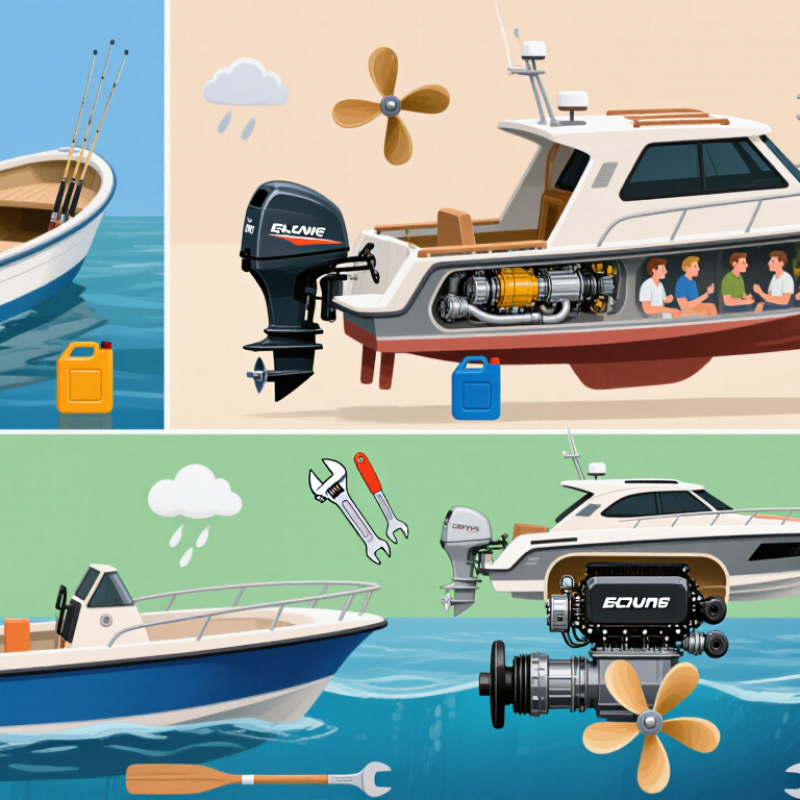
Marine motors differ mainly in where the engine sits and how power reaches the water. An outboard mounts on the transom, with its engine, gearcase, and propeller in one steerable unit. It leaves the cockpit and bilge open, and routine access is often straightforward. Tilt it clear of the water when moored in suitable conditions. The trade-off is weight at the stern, which can affect balance on smaller boats. Not always.
An inboard keeps the engine inside the hull and turns a propeller through a shaft beneath the boat. A rudder steers it, so the propeller does not pivot with the helm. This layout can suit larger boats and steady cruising, but engine access may be cramped.
A sterndrive places the engine inside while sending power through a pivoting drive unit at the transom. It combines inboard engine placement with outboard-like steering and trim. That flexibility adds moving parts.
I would not judge a layout by horsepower alone: check the boat’s weight, intended waters, service access, and how much stern space you need. Even the “best” setup can feel wrong if the boat sits low or maintenance is awkward.
A marine engine’s power rating is useful only when you know how it was measured. ISO 8665 sets out methods for measuring and declaring power for marine propulsion engines. It helps buyers compare published figures on a consistent basis, but it does not predict the exact performance of every boat. The standard concerns combustion engines; electric motors may use different rating methods.
Kilowatts and horsepower describe the same power in different units. One kilowatt equals about 1.341 mechanical horsepower, so a 100 kW rating converts to roughly 134.1 hp. Check which horsepower convention a specification uses, since metric horsepower differs slightly. Numbers need context. A rating measured at the engine does not tell you precisely how much power reaches the water. The propeller, drivetrain, hull shape, load, and operating conditions all affect performance. A heavily loaded boat may feel slower than the rating suggests. That mismatch can be frustrating, and easy to overlook. Compare ratings on the same measurement basis, then consider the boat’s intended use and setup.
The right marine motor depends on the boat’s hull, displacement, load, intended speed, and operating conditions. The ranges below are broad examples, not sizing recommendations.
| Rated power range | Approximate mechanical horsepower | Typical application examples | What to check when comparing motors |
|---|---|---|---|
| 2–5 kW | 2.7–6.7 hp | Small tenders, dinghies, and low-speed auxiliary use | Boat and passenger load, transom compatibility, and whether the rating is continuous or peak power |
| 5–15 kW | 6.7–20.1 hp | Small inflatables and light utility boats | Hull design, carrying load, operating range, and the manufacturer’s stated power-rating basis |
| 15–40 kW | 20.1–53.6 hp | Small runabouts and light fishing boats | Maximum permitted engine power for the hull, propeller matching, and expected cruising conditions |
| 40–100 kW | 53.6–134.1 hp | Many mid-size planing boats and utility craft | Loaded weight, planing performance, cooling requirements, and whether the figure refers to engine or shaft output |
| 100–300 kW | 134.1–402.3 hp | Larger planing boats and some workboats | Duty cycle, drivetrain losses, installation requirements, and the boat builder’s approved power range |
| Term | Meaning | How to use it |
|---|---|---|
| ISO 8665 | An international standard for measuring and declaring power for small-craft marine propulsion reciprocating internal-combustion engines. | Check the engine documentation for the standard edition and the stated measurement point and conditions; ratings are most useful when compared on the same basis. |
| Kilowatt (kW) | A metric unit of power. | Use the declared kW figure to compare engines, while confirming whether it describes engine output or power delivered at another point in the drivetrain. |
| Mechanical horsepower (hp) | A customary unit of power. For conversion, 1 kW is approximately 1.341 mechanical hp. | Convert kW to hp by multiplying by 1.341. For example, 50 kW is approximately 67.1 hp. |
| Engine power versus propeller-shaft power | Power available at the engine output and power reaching the propeller shaft can differ because of drivetrain losses and the stated measurement location. | Do not compare figures with different measurement points as if they were identical; consult the technical specification and installation documentation. |
Important: These application ranges are illustrative only. Follow the boat builder’s maximum-power rating and consult a qualified marine professional for engine selection. Electric-motor peak power, continuous power, and battery energy capacity are separate specifications and should not be treated as interchangeable.
What Are the Best Marine Motors for Boats?
Start with the capacity plate, not a horsepower guess. If your boat carries a U.S. Coast Guard capacity label, treat its maximum horsepower as a ceiling, not a target. Check the hull maker’s recommended engine range too. Hull length alone tells little: a narrow aluminum skiff and a wide fiberglass hull of similar length handle weight and power differently. Count the real load: passengers, fuel, battery, anchor, cooler, and fishing gear. A boat that feels light at the dock may sit much deeper once everyone climbs aboard. Small detail, big effect.
Compare your loaded weight with the hull’s capacity, then choose power that suits how you actually use the boat. A lightly loaded hull on calm lakes may not need the top rating; frequent heavy loads or strong current can change that. Do not compensate for an overloaded boat with a larger motor. The U.S. Coast Guard’s 2023 Recreational Boating Statistics report recorded 4,040 accidents, 564 deaths, and 2,126 injuries. Those figures do not identify horsepower as the cause, but they are a reminder to make careful operating decisions. I would still check the plate twice; estimating gear weight is easy to get wrong.
Illustrative planning ranges for common recreational boats—not a substitute for the boat’s capacity plate or manufacturer guidance.
Boat length alone does not determine the right motor. Compare the boat’s fully loaded weight—including passengers, fuel, and gear—with its design and intended use. Never exceed the maximum horsepower or weight shown on the capacity plate; if the plate is missing or unclear, ask the boat manufacturer or a qualified marine professional.
Gasoline, Diesel, and Electric Motors: Comparing Range and Runtime
Range is not a fixed number on a motor’s specification sheet. Hull shape, passenger weight, sea conditions, and cruising speed all affect fuel use. A gasoline motor is easy to refuel at many marinas, making longer trips practical when fuel stops are available. But pushing a boat faster can raise consumption quickly. A fuel gauge and a measured cruise speed tell you more than a best-case range estimate.
Diesel motors often use less fuel per unit of power than comparable gasoline setups, especially on larger boats cruising steadily. Their fuel capacity and typical cruising burn rate can help estimate hours underway. Still, a heavier load or rough water changes the picture. A full tank does not guarantee a full day of travel.
Electric motors offer quiet operation and predictable energy calculations. Divide usable battery capacity in kilowatt-hours by average motor draw to estimate runtime. For example, a 10 kWh battery supplying 2 kW offers about five hours before accounting for reserve. Keep extra capacity for wind, current, cold weather, and the ride home. That matters. Real trips rarely match tidy calculations, and battery estimates can be wrong. Test your setup on a familiar route, then record speed, load, and energy used.
The best marine motor is not automatically the most powerful or fuel-efficient. Match its output to your boat’s size, typical load, and usual water conditions. An undersized motor may struggle with passengers and gear; an oversized one can add unnecessary purchase and operating costs. Check the boat builder’s capacity guidance and compare efficiency under similar loads, not just advertised peak figures. Real use varies.
Maintenance affects both reliability and long-term cost. Compare scheduled service needs, corrosion protection, parts availability, and expected service life. Saltwater use, frequent short trips, and long periods without use can change maintenance demands. Include fuel or charging costs, routine service, repairs, and installation in your estimate. A simple spreadsheet helps, though it may miss the cost of downtime.
Tips: Ask a qualified marine technician to assess your boat and operating pattern. Review the service schedule before buying, and request written estimates for installation and routine maintenance. Keep a small reserve for unexpected repairs. The cheapest option may not stay cheapest. And efficiency alone is not the whole story.
An outboard mounts on the transom, with the engine, gearcase, and propeller in one steerable unit. It often leaves the cockpit and bilge easier to access. Its weight at the stern can affect a smaller boat’s balance. Not always.
An inboard sits inside the hull and turns a propeller through a shaft. A rudder steers the boat, while the propeller stays pointed straight. This layout can suit steady cruising, but engine access may feel cramped.
Its engine sits inside the boat, while a pivoting drive unit reaches through the transom. This allows steering and trim adjustments. The arrangement has more moving parts to maintain.
No. Consider boat weight, intended waters, service access, and stern space. A powerful motor may still feel unsuitable if the boat sits low or maintenance is awkward.
It gives a measured power figure, not a guaranteed speed on the water. The propeller, drivetrain, hull shape, load, and conditions all affect performance. Numbers need context.
One kilowatt equals about 1.341 mechanical horsepower. For example, 100 kW is roughly 134.1 hp. Check the stated horsepower convention, because metric horsepower differs slightly.
Hull shape, passenger weight, speed, and sea conditions all matter. Faster travel can increase fuel use quickly. A measured cruising speed and fuel gauge offer more useful clues than an optimistic estimate.
Divide usable battery capacity by average motor draw. A 10 kWh battery supplying 2 kW offers about five hours before reserve. Wind, current, cold weather, and the return trip can reduce that time. Test it on a familiar route.
Choosing the best Marine Motors begins with understanding how each drive system fits a boat. Outboards mount outside the hull and are often easier to service, while inboards sit inside the boat and sterndrives combine an inboard engine with an external drive. When comparing power, check how ratings are stated: ISO 8665 provides a standard for measuring marine engine output, and 1 kilowatt equals about 1.341 horsepower. Use the boat’s hull size, fully loaded weight, and capacity plate to guide horsepower selection rather than relying on size alone.
Fuel choice also affects performance and use. Gasoline motors may suit shorter trips, diesel can be practical for longer range, and electric motors offer quiet operation but depend on battery capacity and charging access. To compare options, consider fuel or energy efficiency, expected runtime, routine maintenance, and total ownership costs—not just the initial purchase price. The right motor balances adequate power, suitable range, dependable upkeep, and the boat’s intended use.

Zelt Motor