Top 10 Types of Compact Motors for Buyers

Time:2026-11-02 Author:Sophia
0%

Compact Motors power equipment where space, weight, and efficiency all matter. You might find one inside a camera gimbal, a small pump, or an automated conveyor. Yet a compact housing does not guarantee the right performance. A motor that fits a bracket may still run too hot, lack starting torque, or make unwanted noise. Not always obvious.

This guide introduces ten common motor types, including brushed and brushless DC motors, stepper motors, servos, induction motors, and geared designs. Each works differently, so the best choice depends on the job. A stepper motor can position a light mechanism in measured increments, while a geared motor can turn a heavier load at a lower speed. These examples are useful starting points, not rules for every machine.

For a practical comparison, buyers should check rated voltage, torque, speed, duty cycle, mounting dimensions, and operating temperature. Also consider the driver or controller, available space for wiring, and whether the motor must handle dust or vibration. A few millimeters can decide whether an assembly fits. Small details count. Manufacturer datasheets provide essential specifications, but real operating conditions may differ from ideal test setups. That gap deserves attention. This overview helps you compare the main options and prepare better questions before choosing a motor for a product or project.
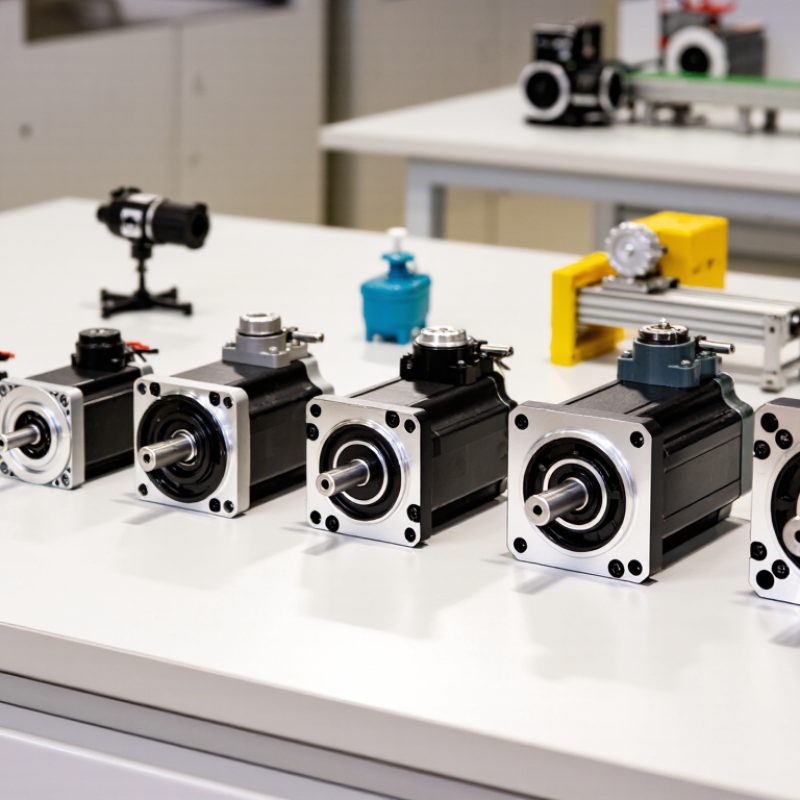
Top 10 Types of Compact Motors for Buyers

Define compact motors by power, frame size, and fractional-horsepower ratings

Compact motors are best defined by three measurable features: output power, frame dimensions, and rated speed or duty. “Compact” has no single universal horsepower or size limit. In common North American usage, fractional-horsepower motors produce less than one horsepower; the label alone does not tell buyers whether a motor fits. Check shaft height, mounting holes, and overall length against the equipment drawing. IEC 60072 standardizes key frame and mounting dimensions, helping buyers compare compatible designs across suppliers.

For a practical shortlist, compare ten common types: AC induction, permanent-magnet, brushless DC, brushed DC, stepper, servo, shaded-pole, universal, synchronous, and gearmotors. These are not all mutually exclusive categories: a gearmotor describes an integrated gearbox, not one electrical motor technology. Small details matter. A 60-millimeter body may still clash with a nearby connector or lack cooling space. The U.S. Department of Energy’s motor-systems resources report that motors use about 70 percent of industrial electricity, underscoring why efficiency and operating hours deserve attention even in compact installations.

Read the nameplate before comparing catalog power. Confirm continuous versus intermittent duty, voltage, current, enclosure, and thermal limits; then assess torque at the actual operating speed. A fractional-horsepower rating can conceal weak starting torque or overload sensitivity. Here’s the catch. Frame standards improve dimensional checks, but they do not guarantee identical shaft extensions or performance. Leave room for measurement—and verify the real load, because buyers sometimes size from the machine’s label rather than its working cycle.

Compare brushed DC, BLDC, coreless, stepper, and servo motor designs

Compact motor selection depends on load, duty cycle, and available control. Brushed DC motors are simple to drive and often economical, but brush wear and electrical noise matter in frequently cycled equipment. BLDC motors avoid brushes and can suit efficient, long-life drives, though they need electronic commutation. It costs space. Coreless describes rotor construction, so it can overlap with brushed or brushless designs. Its low rotor inertia enables quick acceleration, but sustained load can create a thermal problem.

Stepper motors move in increments and can hold position without feedback. Yet resonance or missed steps may appear under changing loads. Servo motors use feedback for precise speed and position control, with added sensor and tuning complexity. A tidy datasheet can still mislead. Check the torque-speed curve and temperature rise under the actual load.

The U.S. Department of Energy’s 2014 Improving Motor and Drive System Performance sourcebook estimates that motor-driven systems use about 70% of U.S. manufacturing electricity. That is an industrial-wide figure, not a compact-motor efficiency rating, but it supports assessing the full drive system. Compare motor, controller, and gearbox together. For a small pump or actuator, test start-up torque, noise, and heat in its real enclosure before choosing.

Explore geared, induction, synchronous, universal, and linear motor types

Geared motors combine a motor with a reduction gearbox, trading speed for higher output torque. They suit compact conveyors, small lifts, and adjustment mechanisms. Check the gearbox ratio and expected duty cycle; a stalled load can quickly raise temperatures. Induction motors are valued for simple construction and steady operation, though speed changes with load. Synchronous motors hold speed closely when matched to the supply or a controller. Noise matters. The International Energy Agency’s 2011 report, Energy-Efficiency Policy Opportunities for Electric Motor-Driven Systems, estimates these systems use about 45% of global electricity. That figure covers motor-driven systems broadly, not compact motors alone, but it shows why efficiency deserves attention.

Universal motors can deliver high speed from a small package, making them useful where brief, powerful operation matters. Their brushes wear, so maintenance and service life need consideration. Linear motors produce straight-line thrust directly, avoiding a rotary mechanism and its conversion losses. They can simplify precise positioning, but their guides and controls still take space. Measure twice. Compare starting torque, speed range, heat, noise, and available mounting area against the real load. A small motor may fit the drawing yet struggle in continuous use. That is an easy detail to miss when choosing by dimensions alone.

Compare torque, speed, duty cycle, and typical 1.8° stepper resolution

Compact motors differ more in operating behavior than their size suggests. Brushed DC motors offer straightforward speed control, while brushless DC motors suit longer-running applications when paired with suitable electronics. Small gearmotors trade speed for higher output torque. Coreless motors can accelerate quickly, but their thermal limits still matter. Check the torque at the actual operating speed, not just the stall figure.

Stepper motors move in discrete increments. A common 1.8° step angle gives 200 full steps per revolution, useful for repeatable positioning. Microstepping can make motion smoother, though it does not guarantee matching positional accuracy under load. Servo motors use feedback to correct position errors, while synchronous motors maintain speed linked to supply frequency. Pancake motors fit shallow spaces; linear motors create direct motion. Vibration motors prioritize oscillation, not controlled rotation.

Duty cycle deserves equal attention. A motor running continuously may need a different thermal rating than one making brief moves with cooling pauses. Watch winding temperature, ambient heat, and the load during startup. Measure the real mechanism. A compact motor can feel strong on a bench, then struggle after a gearbox, belt, or friction is added. It is easy to overlook that. Compare torque-speed curves, rated duty, and drive requirements before choosing; published values may use different test conditions.

Top 10 Types of Compact Motors for Buyers

Compare representative torque, speed, duty cycle, and typical stepper resolution.

The chart shows the midpoint of each indicative torque range; actual ratings vary with motor size, voltage, cooling, and operating conditions. Speed figures are typical operating ranges, not guaranteed ratings. Duty cycle is application- and thermal-design-dependent. A 1.8° stepper has 200 full steps per revolution; microstepping increases command resolution but does not guarantee equivalent positioning accuracy.

Compact motor type Representative torque range Typical speed range Indicative duty cycle Typical resolution
Brushed DC0.05–0.50 N·m1,000–10,000 rpm50–100%Encoder-dependent
Brushless DC (BLDC)0.10–1.00 N·m1,000–10,000 rpm80–100%Encoder or commutation-dependent
Coreless DC0.005–0.10 N·m5,000–20,000 rpm50–100%Encoder-dependent
AC induction0.20–2.00 N·m900–3,600 rpmUp to 100%Encoder-dependent
Universal0.05–0.50 N·m5,000–20,000 rpm20–60%Encoder-dependent
Permanent-magnet synchronous0.05–0.50 N·m500–6,000 rpm80–100%Encoder-dependent
Stepper0.10–1.00 N·m100–1,000 rpm under load50–100%1.8° per full step (200 steps/rev)
Rotary servo0.10–2.00 N·m1,000–6,000 rpm80–100%Encoder-dependent
Geared DC motor0.20–5.00 N·m at gearbox output10–500 rpm at gearbox output20–100%Encoder-dependent
Direct-drive BLDC0.20–3.00 N·m100–3,000 rpm80–100%Encoder-dependent

Check covered AC motors against IEC 60034-30-1 efficiency classes IE1–IE5

Compact AC motors may look interchangeable in a catalog, but efficiency comparisons only work when each motor falls within IEC 60034-30-1’s scope. Check the relevant edition and motor type before comparing IE1, IE2, IE3, IE4, or IE5. The class reflects efficiency under defined conditions; it does not guarantee identical savings in every installation. Small details matter.

Match the rated output, number of poles, supply frequency, and operating conditions when reviewing two motors. Confirm the declared class on the nameplate or technical documentation, and verify which standard edition supports it. Not every compact AC motor is covered. A motor’s frame size or low power rating alone does not establish its IE class. Check the fine print.

Then consider the actual duty cycle. A motor running for long shifts near its rated load may make efficiency differences more valuable than one used briefly. Variable-speed operation, cooling, and driven equipment can also affect system energy use. I would not treat the highest class as an automatic winner; compare purchase cost, expected run hours, and the complete operating setup. Real conditions are rarely tidy.

FAQS

What defines a compact motor?

There is no universal size limit. Compare output power, frame dimensions, rated speed, and duty. Measure shaft height, mounting holes, and overall length.

Does a fractional-horsepower rating guarantee a motor will fit?

No. In common North American usage, it means less than one horsepower. Check the equipment drawing and confirm the motor’s dimensions, torque, and mounting pattern.

Which motor types suit different compact applications?

Brushed DC motors offer straightforward speed control. Gearmotors trade speed for higher output torque. Steppers suit incremental positioning, while servos use feedback to correct position errors. These categories can overlap.

What does a 1.8° stepper rating mean?

It means 200 full steps per revolution. Microstepping can smooth motion, but it does not guarantee accuracy under load. That distinction is easy to miss.

How should I compare motor torque?

Check torque at the actual operating speed, not only the stall figure. Include the gearbox, belt, friction, and startup load. Measure the real mechanism.

Why does duty cycle matter?

Continuous operation creates different thermal demands than brief moves with cooling pauses. Check rated duty, winding temperature, ambient heat, and startup load. Bench tests can mislead.

How can I compare AC motor efficiency classes?

Confirm that both motors fall within the relevant IEC 60034-30-1 scope. Check the standard edition, rated output, pole count, supply frequency, and declared class.

Is the highest efficiency class always the best choice?

Not automatically. Compare purchase cost, expected run hours, load, cooling, and the complete operating setup. Real conditions are rarely tidy.

Do frame standards guarantee a perfect fit?

No. IEC 60072 helps compare key frame and mounting dimensions, but shaft extensions may differ. Leave room for connectors and cooling space. I still find this easy to overlook.

Conclusion

Compact Motors are defined by their power output, frame size, and fractional-horsepower ratings, making them useful where installation space and energy use matter. Choosing the right design starts with the application: brushed DC motors offer straightforward speed control, while BLDC motors provide electronic commutation. Coreless motors emphasize low inertia, steppers move in precise increments, and servos combine controlled motion with feedback. Other options include geared motors for increased output torque, induction and synchronous motors for AC applications, universal motors for versatile operation, and linear motors for direct motion.

Compare each type by torque, speed range, and duty cycle rather than size alone. A common stepper specification is a 1.8° step angle, though actual positioning also depends on the drive and load. For covered AC motors, review efficiency against the IEC 60034-30-1 classes IE1 through IE5. Matching these factors to the required motion, operating conditions, and available space helps buyers narrow their choices.

Sophia

Sophia

Sophia is a dedicated marketing professional with an exceptional depth of knowledge about her company's products and services. With a keen understanding of market trends and customer needs, she crafts insightful blog posts that not only inform but also engage readers, enriching the company’s online......